
 Why Florida Medical Marijuana Patients Have to Renew Every 7 Months
 Why Florida Medical Marijuana Patients Have to Renew Every 7 Months
If there is one part of Florida’s medical marijuana program that continues to confuse patients, it’s the renewal process.
We hear the same questions in our offices every week:
“I just renewed my card. Why do I need to renew with my doctor?”
“ My card says active, so why can’t I purchase anything?”
“Didn’t I already pay the state?”
The confusion is understandable. Florida patients actually have two different things to keep current: their state Medical Marijuana Use Registry identification card and their physician certification.
They are related, but they are not the same thing.
Understanding the difference can prevent an unpleasant surprise the next time you visit a dispensary.
Your Florida MMJ Card and Physician Certification Are Different
This is probably the easiest way to explain it:
Your state card identifies you as a registered Florida medical marijuana patient. Your physician certification authorizes you to receive medical marijuana and establishes your orders in the Medical Marijuana Use Registry (MMUR).
Florida law requires an existing patient to be evaluated by a qualified physician at least once every 30 weeks before receiving a new physician certification. Thirty weeks works out to approximately 210 days, or seven months.
Your state MMUR identification card, on the other hand, has its own renewal process.
This is why a patient can have a state card that still says ACTIVE but have expired physician orders.
It is also why paying the state renewal fee does not replace your physician renewal.
The Easiest Way to Remember It
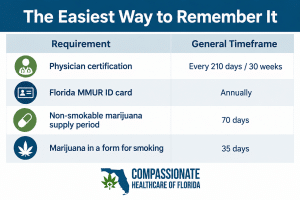
Florida’s medical marijuana program uses several different renewal and rolling supply periods. Keeping track of each one can help prevent unexpected issues when it’s time to visit a dispensary.
“My Florida Medical Marijuana Card Is Active. Why Did My Orders Expire?”
This is one of the most common questions we receive.
An active state card doesn’t necessarily mean that you currently have active physician orders.
Think of them as two separate expiration dates.
You might renew your state registration in January, for example, but your physician certification could be due for renewal in April. Renewing one does not automatically extend the other.
If your physician certification expires, a dispensary cannot simply create new orders for you. Your certification and orders are handled through your qualified medical marijuana physician.
That is why we recommend paying attention to both dates, rather than relying only on the expiration date printed on your state card.
What Happens at the 7-Month Renewal?
A renewal is more than simply changing an expiration date in the Registry.
Florida law requires the qualified physician to determine whether the patient continues to meet the requirements for certification. The physician also reviews and updates the patient’s certification information in the Medical Marijuana Use Registry.
This is also a good opportunity to talk with your physician about how your current recommendation is working.
For example, has your usage changed? Are the routes currently available to you appropriate? Are your existing limits meeting your needs? Have there been changes to your medications or medical history?
Not every patient needs changes at every renewal. Sometimes the appropriate decision is simply to continue the existing recommendation.
Why Do I See 70-Day Orders If My Certification Lasts 210 Days?
This causes almost as much confusion as the renewal itself.
A 210-day physician certification does not mean that Florida gives a patient one unrestricted 210-day supply.
For non-smokable routes, Florida’s system operates around 70-day supply periods. Smoking marijuana is subject to a separate 35-day supply limitation.
So when you look at your Registry, you may see several different dates and order periods even though your physician certification covers approximately seven months.
The dates aren’t errors. They represent different parts of Florida’s system.
When you see “Scheduled”, that order set will begin automatically when the prior one (either 70-days for medical marijuana or 35-days for flower) ends.
“I Haven’t Used All My Milligrams. Why Can’t I Buy More?”
Here’s where things get a little more complicated.
Florida uses rolling supply limits.
For non-smokable marijuana, the Registry looks back at dispensations during the preceding 70 days. For marijuana in a form for smoking, it looks back over the preceding 35 days. The amount a dispensary can dispense on a particular day depends in part on the patient’s prior dispensations during those rolling periods and the amount remaining on the current order.
That means the available amount displayed in the Registry isn’t always as simple as: Monthly limit − what I bought this month = what I can buy today.
Patients sometimes expect everything to reset on a particular date. Because the limits are calculated on a rolling basis, previously purchased amounts become available again according to when those prior dispensations occurred.
If you’ve ever looked at your Registry and wondered why your available amount changed on a seemingly random day, this may be the reason.
Can My Routes or Amounts Be Changed at My Renewal?
Yes, your physician can review your routes and amounts at your renewal and make changes when appropriate.
Although the state does have supply limits, Florida’s Registry allows the physician certification to specify the amount and forms of marijuana authorized for a patient.
At Compassionate Healthcare of Florida, we include all routes of administration with our certification rather than charging patients separately for individual routes.
However, the physician still determines what is medically appropriate for each individual patient.
The same applies to dosage amounts.
Two patients with the same diagnosis do not necessarily need identical recommendations. Medical history, response to treatment, current usage and other clinical considerations can all matter.
What If the Standard Florida Limits Aren’t Enough?
Florida provides a process commonly called a Request for Exception, or RFE, through which a qualified physician may request authorization above certain state-established dosage or supply limits when medically appropriate.
An RFE isn’t automatically appropriate simply because a patient would like to purchase more.
It is a medical request made by the physician based on the patient’s individual circumstances.
At Compassionate Healthcare of Florida, RFE requests are included when medically appropriate. We don’t charge our patients an additional physician fee simply for submitting an appropriate RFE.
Do I Have to Go Back to the Office Every 7 Months?
Not necessarily.
Florida requires the initial certification examination to be performed in person.
For subsequent certifications, Florida law permits telehealth when the qualified physician previously issued a certification to that patient after conducting the required in-person physical examination.
This distinction is important.
A patient who has never been seen in person by the certifying practice may have different requirements than an established patient renewing with a physician who has already completed the required in-person examination.
For eligible established patients, telehealth can make the seven-month renewal considerably more convenient.
What Happens If I Forget to Renew My Physician Certification?
Usually, patients discover this at the worst possible time: when they’re trying to make a purchase.
If your physician certification and orders are no longer active, having an otherwise active state MMUR card does not by itself give a dispensary an active physician order to dispense against.
You’ll need to complete the appropriate physician renewal before new orders can be entered. For eligible established patients, the renewal may be completed by telehealth, making the process quick and convenient.
This is why we encourage patients not to wait until they’re standing at the dispensary to check their status.
If your renewal date is approaching, handling it ahead of time can help avoid an interruption.
“I Paid the State $75. Didn’t I Already Renew?”
You renewed one part of the process.
The State of Florida’s registration fee is separate from the fee charged by your physician for the medical evaluation and certification.
At Compassionate Healthcare of Florida, our current renewal and transfer certification includes the physician renewal evaluation, 210-day certification, Registry updates, all routes of administration and RFE requests when medically appropriate. The state registration fee is paid separately to Florida OMMU.
We believe this distinction should be clear before a patient makes an appointment. There shouldn’t be surprise physician charges later for adding a route or requesting an exception that the physician determines is medically appropriate.
Florida has also updated the state renewal process. Patients must now have a current or scheduled physician certification with active orders before submitting their MMUR card renewal application.
A Simple Way to Check Before Going to the Dispensary
Before making a trip, particularly if you haven’t purchased in a while, check the Florida Medical Marijuana Use Registry.
Don’t look only at whether your card says active.
Look at your physician certification and current orders as well.
If something doesn’t look right or you aren’t sure what you’re looking at, call your certifying physician’s office. In many cases, the issue is easier to understand once someone explains which date or available amount you’re actually seeing.
The Bottom Line
Florida’s medical marijuana renewal system isn’t particularly intuitive.
The most important thing to remember is that your state MMUR card and your physician certification are two separate requirements.
Your state registration is renewed separately, while Florida requires your physician to reevaluate you at least every 30 weeks before issuing a new certification. Your orders and available amounts operate on still other timelines.
Once you understand that distinction, most of the confusing dates in the Registry start to make a lot more sense.
Compassionate Healthcare of Florida provides new patient certifications, transfers and renewals at our Naples, Cape Coral and Aventura locations. Eligible established patients may also be able to complete their renewal through telehealth.
If you’re unsure when your physician certification expires or have questions about your current orders, our staff can help you understand what you’re seeing in the Registry.


